
IKIGAI Journal
How Long Does It Take to See Results From Yoga?
A realistic timeline for changes in mobility, strength, stress, sleep, and confidence, without promising that every body will respond in the same way.
Yoga can create meaningful changes, but there is no single week in which every practitioner suddenly becomes calmer, stronger, or more flexible.
The timeline depends on your starting point, the type of class, how regularly you attend, whether you are recovering from pain or injury, and what you mean by “results.”
Some people notice an immediate change in how they feel after one class. Physical changes usually require repeated exposure over several weeks. Improvements in strength, mobility, balance, pain management, or stress regulation tend to develop gradually and do not always progress in a straight line.
A useful distinction
Feeling better after class is not the same as creating a lasting adaptation.
A single session may leave you feeling less tense or more settled. A durable change in strength, mobility, movement confidence, or stress response requires consistent practice over time.

“Early progress is often something you feel before it becomes something you can see.”
What Can Change in the First Two Weeks?
During the first few classes, the most noticeable changes are often immediate and subjective. You may feel less physically tense after class, become more aware of your breathing, or find it easier to settle at the end of the day.
Research suggests that yoga may support stress management and sleep in some populations, but the size and timing of the effect vary considerably. It is more accurate to say that some beginners notice better sleep or a calmer state within the first weeks than to present this as a guaranteed biological response.
You may also experience temporary muscle soreness, particularly when the practice includes movements your body is not accustomed to. Mild soreness after unfamiliar exercise can be normal. Sharp pain, joint pain, numbness, or symptoms that persist or worsen should not be dismissed as part of the process.
Awareness
You begin to notice where you hold tension and how you respond to effort.
Familiarity
The class structure, basic postures, and use of props feel less unfamiliar.
Short-Term Relief
Some people feel calmer, less stiff, or better prepared for sleep after practice.
You may not look different.
You may already move and feel differently.
Weeks Three to Six: When Does the Body Start to Adapt?
After several weeks of regular practice, the movements usually become more familiar. This does not mean every posture becomes easy. It means your body is learning how to organise itself more efficiently.
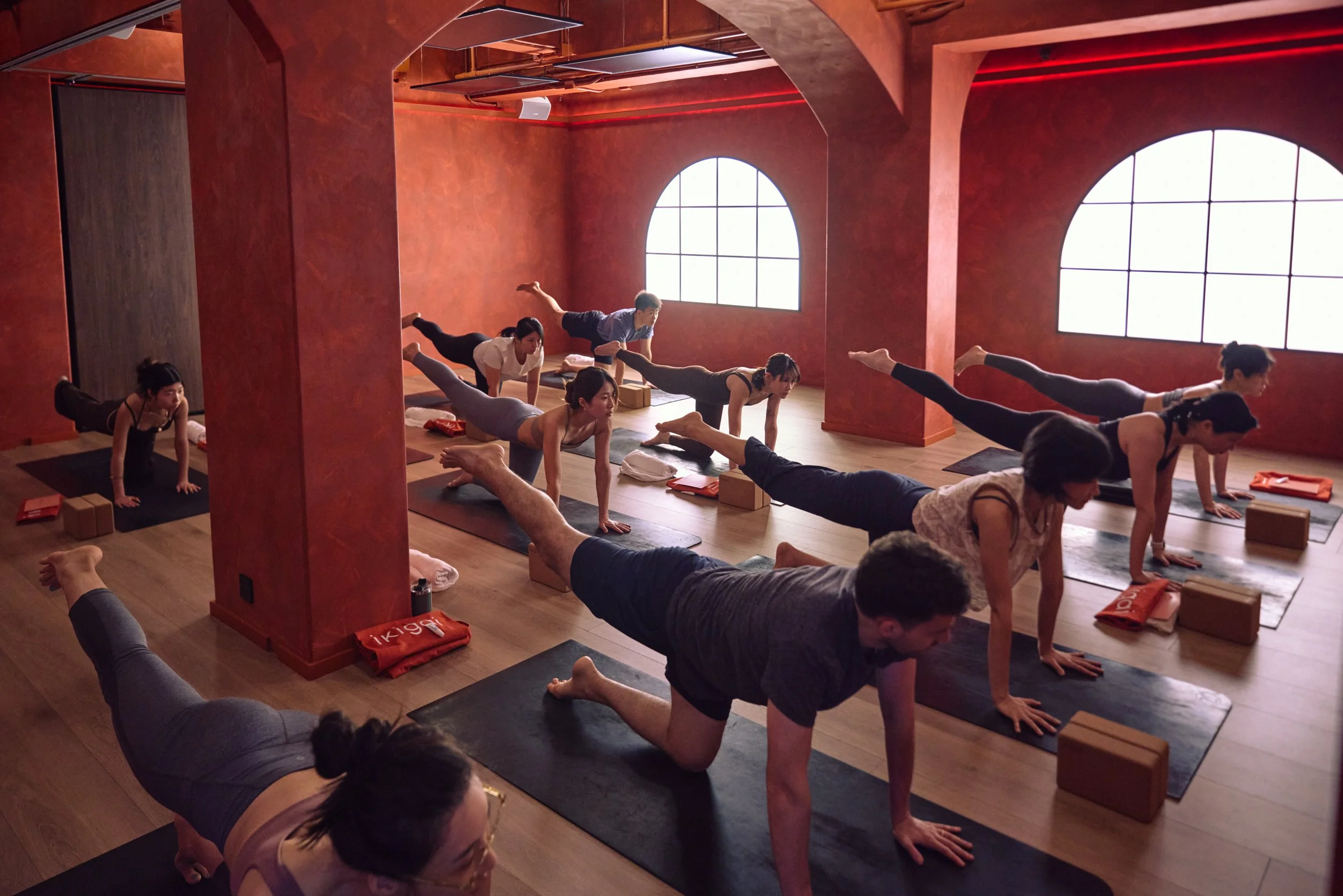
You may be able to hold a plank for longer, distribute weight more comfortably in downward-facing dog, or move through transitions with less hesitation. Improvements at this stage often reflect a combination of strength, coordination, confidence, and better understanding of technique.
Mobility may also begin to improve, particularly when a class regularly explores the hips, shoulders, spine, and hamstrings. The degree of change depends partly on anatomy, previous activity, age, injury history, and the type of practice.
For people managing persistent lower-back pain, yoga may be a useful part of a broader care plan. Evidence supports yoga as a possible option for improving pain and function in some people with chronic low-back pain, but it is not an automatic cure and the class must be appropriate for the individual.
New or unexplained back pain, radiating pain, weakness, numbness, loss of bladder or bowel control, or pain following trauma requires medical assessment. A yoga teacher should not diagnose the cause of pain.
A slower class such as Hatha, Align, Gentle Flow, or a suitable Level 1 practice may make it easier to learn technique and modify movements. Faster or more intense classes are not necessarily harmful, but they leave less time for explanation and may be unsuitable during a sensitive phase.
Months Two to Three: When Do Changes Become More Noticeable?
Eight to twelve weeks is a more realistic period in which to assess physical progress. By this point, someone attending regularly has accumulated enough practice for changes in strength, mobility, balance, and movement control to become easier to recognise.
You may notice that standing postures feel more stable, that you recover more quickly between stronger sequences, or that everyday movements require less effort. Changes in posture may also become apparent, but posture should not be reduced to forcing the shoulders backwards or holding the body rigidly.
A more useful sign is improved postural capacity: the ability to sit, stand, and move through different positions with less unnecessary tension and more options.
Flexibility often develops unevenly. One area may change quickly while another changes very little. Progress may also appear to plateau as the early neurological familiarity gives way to slower tissue and strength adaptations.
Longer holds, steadier transitions, and better control under load.
More usable range of movement, rather than simply reaching further.
Better coordination and more confidence when stability is challenged.
Less dependence on copying the room and more understanding of your own setup.
Months Four to Six: What Deeper Changes May Develop?
After several months, the value of practice may become less about isolated postures and more about repeatable skills.
You may recognise tension earlier, regulate your effort more effectively, or pause before reacting automatically to discomfort. Breath awareness and attentional training can become easier to apply outside the studio, although this is not guaranteed and should not be presented as a cure for anxiety or chronic stress.
Research on yoga and anxiety suggests possible short-term benefits for symptoms, while evidence for treating anxiety disorders remains inconclusive. Someone experiencing significant or persistent anxiety should seek appropriate clinical support rather than relying on yoga alone.
Physical symptoms may improve during this period, particularly when practice is well matched to the person and combined with appropriate medical or rehabilitation care. Persistent injuries do not reliably “resolve” because of yoga, and certain conditions can worsen when movements are poorly selected or aggressively performed.
“The deeper result is not becoming unaffected by stress. It is developing more options in how you respond to it.”
Beyond Six Months: When Does Yoga Become a Practice?
After six months, yoga often feels less like a new activity and more like part of a regular routine. You understand which classes support you, which movements need modification, and how frequently you can practise without neglecting recovery.
Physical gains may continue, but usually at a less dramatic rate than during the earliest stage. Progress also becomes more specific. One person may focus on strength and balance, another on managing stiffness, and another on breathwork or meditation.
Some students choose to study yoga in greater depth through workshops or teacher training. This does not need to be a professional decision. A structured training can also appeal to students who want more time for anatomy, philosophy, teaching methodology, and the wider context of the practice.
What Slows Progress Down?
Progress is rarely limited by a lack of effort alone. More often, it is slowed by an approach that is difficult to sustain or poorly matched to the person.
Inconsistent attendance.
Four classes in one week followed by several weeks away provides less repeated exposure than a modest schedule maintained consistently. Skills develop through regular practice, not occasional intensity.
Choosing intensity before technique.
A challenging class can be useful, but difficulty is not automatically more effective. If speed, heat, or fatigue prevents you from understanding the movement, a more foundational class may produce better long-term progress.
Using flexibility as the only measure.
Reaching further does not necessarily mean moving better. Strength, control, balance, breathing, confidence, and the ability to modify intelligently are equally meaningful signs of progress.
Comparing yourself with the room.
Differences in anatomy, training history, age, and experience make direct comparison unreliable. The most useful reference point is how your own movement and response have changed over time.
Ignoring pain and recovery.
Training through pain does not accelerate adaptation. Sleep, nutrition, recovery, stress, and other forms of activity all influence how the body responds.
How Often Should You Practise?
There is no research-backed universal minimum that guarantees a particular result. For many beginners, two classes per week is a practical and sustainable starting point. Three may create more familiarity if your body is recovering well and the classes vary appropriately.
One weekly class can still be valuable, especially when consistency is the priority. Four or more sessions may suit experienced practitioners, but frequency should rise gradually and should account for intensity, recovery, other exercise, and current health.
Useful for maintaining contact with the practice and building a manageable habit.
A realistic range for developing familiarity and assessing change over time.
Potentially appropriate when intensity is varied and recovery remains adequate.
A short home practice can add repetition without adding another full class. Ten minutes of breathing, mobility, or a few familiar postures may be useful, but it should reinforce what you understand rather than become an unsupervised attempt at advanced movements.
How Should You Measure Progress?
Progress becomes clearer when you measure more than appearance or one difficult posture.
Can you breathe steadily during moderate effort?
Do transitions feel more controlled?
Can you recognise when a modification is appropriate?
Has your usable range of movement changed?
Are you recovering well between classes?
Is the practice becoming easier to fit into your real week?
Measure function.
Measure consistency.
Measure how intelligently you practise.
Where Should You Start?
Begin with a class that matches your current experience rather than the level you hope to reach later.
IKIGAI offers beginner-friendly and Level 1 options across Central, Causeway Bay, and Tsim Sha Tsui. The 14-Day Starter Program gives new students time to try different teachers and practice formats before choosing a longer-term rhythm.
A useful first experiment is simple: practise twice a week for six weeks, keep the class intensity appropriate, and pay attention to several measures of progress rather than one. Notice changes in comfort, control, recovery, mobility, sleep, and confidence without expecting every category to improve at the same speed.
Start With a Measurable Baseline
Fourteen days to explore. Six weeks to begin assessing a pattern.
Begin the Starter ProgramChoose beginner-friendly classes and increase frequency gradually.
Yoga does not produce identical results on an identical schedule. What it offers is a method: repeated movement, attention, breathing, and recovery applied consistently enough for change to become possible.
Practise consistently. Assess honestly. Progress intelligently.
Frequently Asked Questions
Can one yoga class make a difference?
One class may create a short-term change in tension, mood, breathing, or body awareness. Lasting physical adaptations require repeated practice over time.
How quickly does yoga improve flexibility?
Some people notice changes within several weeks, while others progress more slowly. Anatomy, practice type, training history, age, injury, and frequency all influence the result. Flexibility should also be accompanied by strength and control.
Can yoga improve posture?
Yoga may improve strength, mobility, awareness, and the ability to use different positions comfortably. These can support better postural capacity, but there is no single perfect posture and forcing the body into a rigid position is not the goal.
Can yoga cure lower-back pain?
No single practice can promise a cure. Research suggests yoga may improve pain and function for some people with chronic low-back pain. Persistent, severe, or unexplained symptoms should be assessed by a qualified healthcare professional.
Does yoga reduce anxiety?
Yoga may help some people manage anxiety symptoms, but evidence for anxiety disorders is not conclusive. It should complement, not replace, appropriate mental-health care when symptoms are significant or persistent.
Is practising every day better?
Not automatically. Daily practice may be appropriate when intensity varies and recovery is adequate. For many beginners, two or three well-chosen sessions per week is more sustainable than beginning with an excessive schedule.
When should I stop or modify a posture?
Stop or modify when you experience sharp pain, joint pain, numbness, tingling, dizziness, unusual shortness of breath, or a sense that you cannot control the movement safely. Tell the teacher and seek medical advice when symptoms are concerning or persistent.