

IKIGAI Journal
What is the 80% Rule?
There is one simple idea that can save you weeks of frustration in yoga: never go beyond 80% of your maximum.
That is where practice stays intelligent, safe, and sustainable.
Most people arrive at yoga with a familiar idea of progress. Go deeper. Push further. Hold longer. Try harder. It makes sense, because this is how many of us have learned to approach work, fitness, and life in Hong Kong. The calendar is full, the pace is fast, and the habit is to squeeze more out of everything.
But yoga does not always reward that mindset. In fact, it often exposes it.
The 80% Rule is not an ancient Sanskrit law. It is not a medical prescription. It is a practical teaching principle. It means you practise at a level where you are clearly engaged, but not straining. You feel effort, but you can still breathe. You are challenged, but you are not fighting your body.
It is the difference between using yoga to build a better relationship with yourself, and using yoga as another place to perform.

“The goal is not to push harder. The goal is to stay present enough to learn.”
What 80% Means in Practice
The number itself is approximate. Nobody is asking you to calculate 80% of a forward fold, a warrior pose, or a backbend. The point is to create a clear internal reference.
At 100%, you are at your edge. The pose may look impressive, but inside there is often gripping, breath-holding, jaw tension, facial strain, or a quiet sense of panic. You may technically be “doing” the shape, but the nervous system is not learning ease. It is learning threat.
At 50%, you may be too passive. The body is present, but not sufficiently engaged. There is not enough attention, structure, or active participation to create meaningful change.
Around 80%, something more useful happens. You feel the work. You feel the stretch, the strength, the balance, or the coordination required. But you still have access to your breath. You can listen. You can adjust. You can come back and practise again tomorrow.

This is why the 80% Rule is so useful for beginners. It gives you permission to stop treating intensity as the only measure of success. It also gives experienced students a more refined question: am I practising with awareness, or am I just trying to prove that I can go further?
The Breath Test
One of the simplest ways to understand your 80% is through the breath.
In exercise science, tools like the Rate of Perceived Exertion scale and the “talk test” are commonly used to help people estimate intensity without needing complicated equipment. They are not yoga-specific tools, but the principle is useful: your body gives you information about how hard it is working.
The same idea applies on the mat. If a pose has you holding your breath, clenching your jaw, gripping your face, or forcing yourself to stay in position, you have probably gone too far.
This does not mean the practice should always feel easy. Yoga can be physically demanding. A strong Vinyasa class, a long standing sequence, a deep hip opener, or a balancing posture can all require real effort. But effort and strain are not the same thing.
At 80%, the breath stays steady.
The body stays responsive.
The mind stays available.
This is especially important in a city where many people already arrive in class overstimulated. After a full day of messages, meetings, transport, deadlines, and noise, the body may not need another experience of being pushed. It may need challenge, yes, but challenge with enough safety for the system to actually absorb it.
Why Pushing Harder Can Slow You Down
There is a common misunderstanding around flexibility. Many people think that if they feel tight, the solution is to pull harder, hold longer, or force the body to “open.”
In reality, your range of motion is influenced by many factors, including tissue tolerance, strength, coordination, previous injuries, stress, fatigue, and how safe your nervous system feels in that position. When the body senses threat, it often protects itself by tightening, bracing, or limiting movement.
So when you push aggressively into a pose, especially while holding your breath, you may be sending the exact message you do not want to send: this position is unsafe.
The 80% Rule works because it gives the body a better learning environment. Instead of forcing change, you give the system repeated experiences of safe challenge. Over time, this can help you build capacity, confidence, coordination, and range.
“Progress is built through repetition, not force.”
What 80% Looks Like on the Mat
The 80% Rule is not about doing less. It is about practising with more intelligence. Here is how it may show up in class.
You choose the version you can breathe in.
If the full version of a pose makes your breath disappear, you take a variation. That may mean bending the knees, using blocks, lowering the arms, shortening the stance, or stepping out of the pose earlier.
This is not failure. It is technique. A pose that you can breathe in will usually teach you more than a pose you are simply surviving.
You stop before pain becomes the teacher.
Discomfort and pain are not the same thing. A strong stretch, muscular effort, or balance challenge can be part of the practice. Sharp pain, joint pressure, numbness, tingling, or a feeling that something is not right should not be ignored.
Yoga research generally suggests that yoga can be practised safely, but adverse effects do happen, especially when people overdo advanced postures, practise without enough guidance, or ignore their body’s signals. The safest approach is not fear. It is attention.
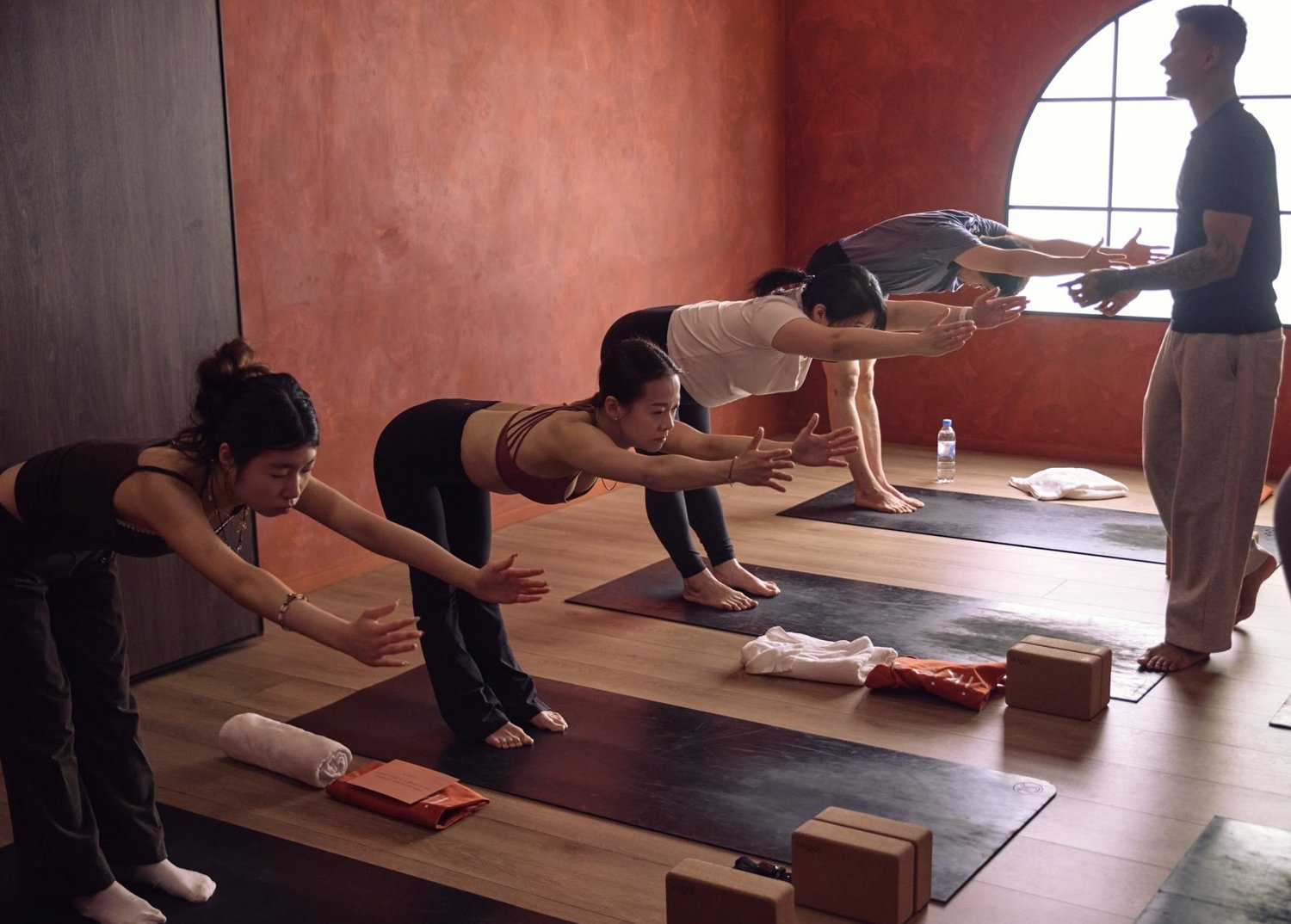
You stay steady enough to refine the movement.
When you are at maximum effort, your attention narrows. You are no longer learning the details. You are just trying to stay in the pose.
At 80%, there is room to notice. Where is the weight in your feet? Are your shoulders climbing toward your ears? Are you locking the knee? Are you collapsing into the lower back? Are you moving with control, or rushing through the transition?
This is where technique improves. Not at the point of panic, but at the point where effort and awareness can still exist together.
You leave class with something left.
A good yoga class does not have to empty you completely. Sometimes you will sweat. Sometimes your legs will shake. Sometimes you will meet real resistance. But the practice should not consistently leave you depleted.
The point is not to win one class. The point is to build a practice you can sustain through busy weeks, stressful seasons, and ordinary life.
The Hong Kong Problem
The 80% Rule is particularly relevant here because Hong Kong rewards over-effort. People are used to running close to capacity. Long working hours, dense schedules, high expectations, and constant stimulation make “maximum” feel normal.
Many students do not arrive at yoga fresh. They arrive after holding themselves together all day. Their shoulders are already tense. Their breath is already shallow. Their mind is already moving fast.
In that state, going straight to 100% can easily become another version of the same pattern that created the tension in the first place. More pressure. More pushing. More performance.
The 80% Rule offers a different kind of discipline. Not softness for the sake of softness, but restraint with purpose. The ability to stay engaged without tipping into force. The ability to challenge the body without turning the practice into another demand.
“Balance beats intensity. Consistency beats force.”
Why 80% Leads to Progress
Progress in yoga rarely comes from one heroic effort. It comes from repetition. The body changes through repeated exposure, repeated attention, repeated practice, and repeated recovery.
When you practise at 80%, three things become more possible.
Consistency
You can come back and practise again tomorrow.
Better technique
You stay aware enough to refine the movement.
Long-term progress
Sustainable effort leads to real change over time.
This is why the most experienced students are not always the ones who push the hardest. Often, they are the ones who know when to soften, when to modify, when to breathe, and when to stop.
They understand that yoga is not just the ability to reach a shape. It is the ability to remain aware inside the process of reaching it.
A Better Way to Measure Success
The next time you are in class, try replacing the question “How far can I go?” with a better one.
Can I breathe here?
Can I stay present here?
Can I return tomorrow?
These questions change the practice. They shift the focus from performance to relationship. From forcing the body to listening to it. From chasing intensity to building trust.
This does not make the practice easier. In many ways, it makes it more honest. It asks you to notice the moment when effort becomes ego, when discipline becomes punishment, when ambition starts to override intelligence.
That moment is where yoga becomes interesting.
At IKIGAI, we believe yoga should help you think more clearly, move more freely, and live more joyfully. The 80% Rule is one way to practise that philosophy directly on the mat.
Challenge without strain.
Find Your Next ClassSources and further reading
- Cleveland Clinic, Rated Perceived Exertion Scale
- CDC, Measuring Physical Activity Intensity
- Cramer et al., The Safety of Yoga, American Journal of Epidemiology
- Cramer et al., Adverse Effects of Yoga, BMC Complementary Medicine and Therapies
- Legislative Council Secretariat, Workplace Mental Health in Hong Kong